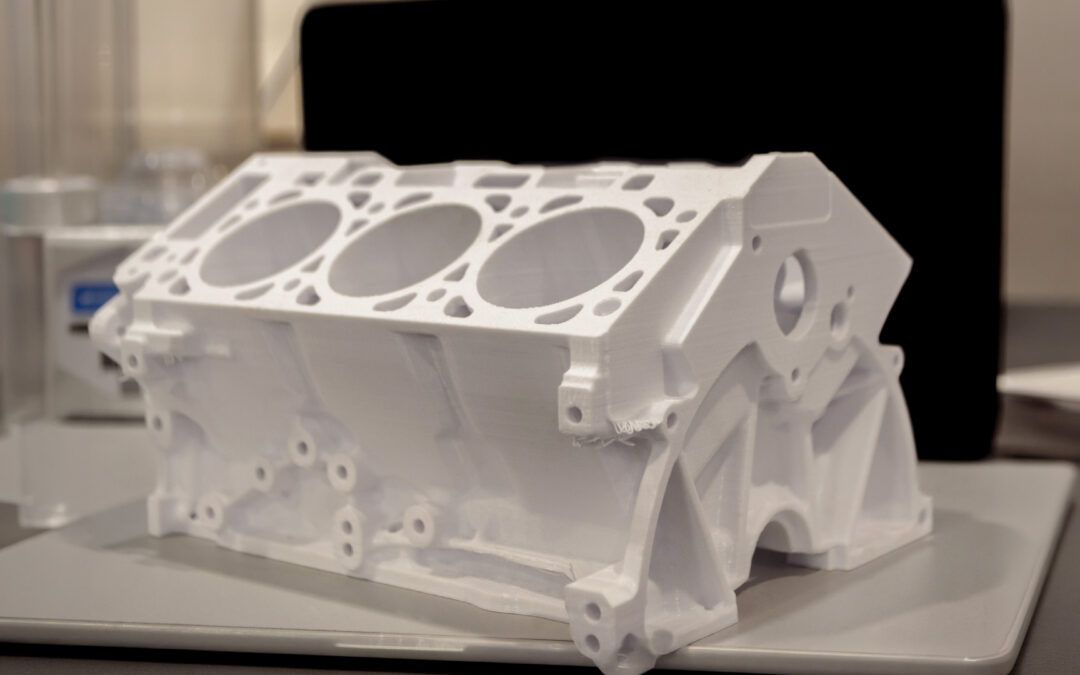
I’ve worked in supply chain management for more than 25 years. I’ve seen extraordinary advances in how original equipment manufacturers (OEMs) source parts and materials and manage complex global logistics. However, I have never seen a technology with the potential to reduce costs, complexity, and time of OEMs’ supply chains like additive manufacturing, or specifically, 3D printing.
Anyone who follows business news is aware that additive manufacturing (AM) technology is advancing at a stunning pace. What was once a niche technology for prototyping and making specialty parts 10 years ago has now advanced for vendors to make certified aerospace components and human bones, houses and automobiles, SpaceX rocket engines and drones for national defense.
AM technology now prints items in steel, aluminum, copper, and many alloys. Even wood filament can be printed. Not only are these materials printable, companies have innovated ways to manipulate material science and additively manufacture metals that withstand natural forces like heat or pressure more than they could previously. For example, companies have hot tested and qualified aluminum for rocket parts that must endure high temperatures and pressure applications in space.
Today it is possible to print complex geometries and weigh optimized parts that were impossible to manufacture with traditional technologies. Such advances alter the possibility for products and parts, enabling greater capabilities with better economics. AM equipment makers and 3D printing vendors are on pace to achieve many more innovative applications in the coming months.
Overcoming Obstacles to Broader 3D Printing Adoption
Despite AM’s growing presence in supply chains, 3D printing adoption lags among OEMs in industries that could leverage it the most, such as aerospace and defense, heavy equipment, automotive, and other industries. These OEMs stick with traditional playbooks for stocking parts their customers need, such as making lifetime or “last time” buys of parts on the verge of being discontinued or commissioning a manufacturer to spin up custom tooling and make a minimum order quantity of legacy parts.
Supply chain professionals who follow 3D printing closely see how much time, cost, and complexity the technology removes from aftermarket inventory practices. it is a great economical fit for low-volume mechanical parts, particularly where suppliers mandate large MOQs and high tooling costs. In fact, 3D printing has been successfully used to rapidly produce tooling and molds at lower cost.
But there are legitimate challenges that limit 3D printing’s viability. AM is not suitable for high-volume production. I’m aware that in many instances, regulatory requirements, qualification timelines, and engineering resource constraints often outweigh the perceived benefits of using 3D printing for aftermarket parts. And it must be acknowledged that using 3D printing to replace traditional manufacturing on a large scale — whether CNC machining, metal stamping, injection molding or other common technologies — can be complex and risky.
Simply determining which parts can be 3D printed and which AM technologies and vendors can meet technical requirements is a daunting problem. 3D printing technology is improving at an astonishing pace, exacerbating the challenge by creating more options for procurement teams to consider.
For many parts, the necessary CAD and 3D drawings don’t exist. For regulated industries, the primary barrier is not technical feasibility but qualification, validation, and long-term liability.
When technical and quality specs can be met with assurance, procurement teams still face the challenge of making a solid business case with full-cycle ROI for 3D printing legacy parts.
Possibility to Reality: 3D Printing Meets AI
This is a challenge that is increasingly complex and dynamic for traditional procurement processes. It calls for advanced intelligence, up-to-date knowledge of the 3D printing industry and vendors, and the capability to quickly review options and make recommendations. These are capabilities that only a thoroughly trained AI agent can provide.
Agentic AI, like that offered by Accio3D, can quickly evaluate aftermarket parts to determine if they’re printable. Agents can determine the best materials and types of 3D printing technology for a part, commission or create CAD or 3D drawings if needed, and flag items that require additional engineering or redesign. They can generate RFQs for shortlisted vendors and manage qualification and testing. AI agents can even handle transaction and shipping details.
For many types of parts, such as those integrating semiconductors or advanced electronics, 3D printing is not ready. It will not generate favorable ROI on parts with high and predictable annual demand, specialized alloys or surface treatments, and long-standing suppliers with guaranteed service levels. Agents will screen those items as “not printable.”
For other aftermarket parts, AI agents can identify and prioritize 3D printing opportunities that even the most advanced procurement teams have difficulty finding. AI reduces the time required to evaluate printability, identify viable suppliers, and build a business case — areas that require significant manual effort.
3D printing is no longer a futuristic novelty. It’s a maturing manufacturing option with real implications for aftermarket inventory. The question isn’t whether additive manufacturing can ease the burden of stocking slow-moving, long-tail spare parts, but how quickly OEMs can overcome the practical barriers to using it wisely — and how effectively AI can help turn that potential into disciplined, profitable execution.